
From weeks of maintenance-heavy Selenium workflows to fast, reliable releases with Spur




Challenge
Before Spur, QA at UncommonGoods was slow, maintenance-heavy, and hard to scale. The team relied on Selenium, DevOps coordination, and offshore support just to keep tests running, with large, redundant test suites that were brittle and time-consuming to maintain. Complex releases could take weeks to QA, and despite the effort, coverage ramped slowly and site reliability still landed around 89–92%, turning QA into a bottleneck for shipping.
Solution
UncommonGoods replaced Selenium with Spur’s AI-powered testing, moving to dynamic, adaptive test cases that are faster to write and easier to maintain. Within weeks, they consolidated 150+ tests into ~30, reduced maintenance from ~50% to ~10% of their time, and began running regression more frequently with minimal overhead. Spur also surfaces bugs in key flows like checkout, helping the team catch issues earlier and focus manual testing where it matters most.
Results
90%+ Test accuracy achieved in weeks (vs. months with Selenium)
- 50%
Reduction in release time - 90%+
Test accuracy achieved in weeks (vs months) - 150 → 30
Consolidated test cases - $300k+
Saved in QA Costs across the board
“The more you use Spur, the smarter it gets. The smarter it gets, the faster you can write tests and find bugs.”

From Maintenance-Heavy QA to Fast, Reliable Releases
Before Spur, QA at UncommonGoods was dominated by maintenance. Teams spent significant time coordinating with DevOps and maintaining fragile test infrastructure instead of validating the product itself.
Regression testing required extensive preparation, and for complex releases, QA cycles could take weeks. Even then, gaps remained, and bugs still reached production.
With Spur, that dynamic flipped.
Maintenance dropped to about 10% of total effort. Running tests became fast and intuitive, allowing the team to execute regression multiple times per week instead of relying on a single release cycle.
“You’re not spending 50% of your time doing maintenance anymore… you’re spending maybe 1%, and boom, you run it.”
The biggest impact came during complex launches.
A release that previously required weeks of QA effort was automated in just one to two days, saving roughly 10 business days and dramatically accelerating time to deploy.
“Time is money, and that’s the strength of Spur.”
Spur also enabled faster ramp-up to reliable coverage. While Selenium took months to reach 90% accuracy, Spur achieved the same benchmark in just weeks.
At the same time, overall site reliability improved. Spur consistently identified clusters of bugs in high-impact areas like checkout, increasing functional reliability from 89–92% to 95–98%.
“That’s above industry standards… a pretty good indicator of how good Spur is.”
By consolidating redundant tests, the team reduced their suite from 150 to 30 cases, making QA more efficient while improving real coverage.
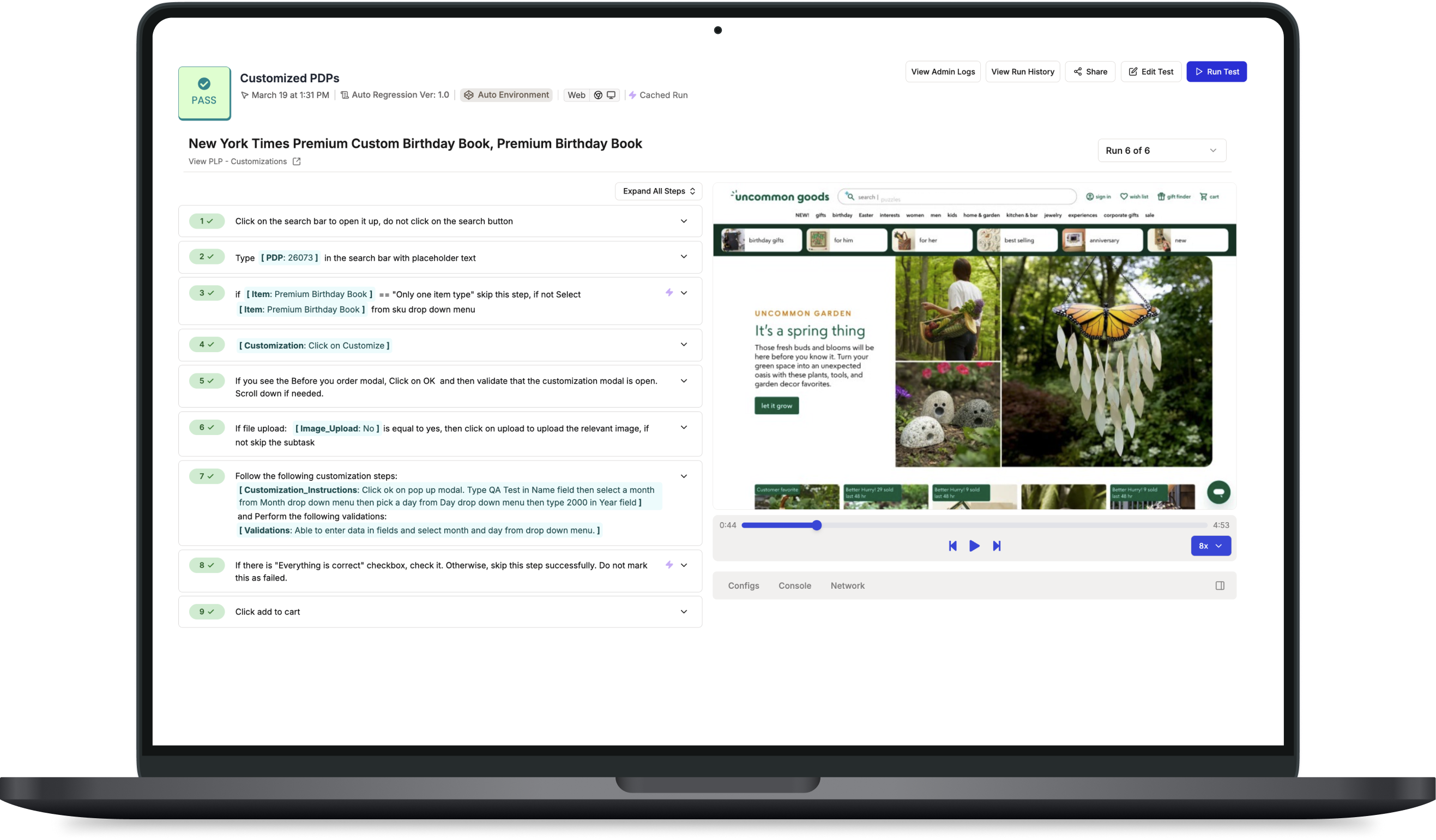
With regression testing automated, QA shifted from repetitive execution to higher-value work:
- Edge case and exploratory testing
- Expanding automation coverage
- Evaluating internal tools for automation
- Reducing manual QA by an additional 25–40%
Spur didn’t just speed up QA. It made it a strategic function.
“It’s allowed employees to focus on what they’re really good at instead of just busy work.”
Looking ahead, UncommonGoods is using Spur as their primary tool to catch blockers earlier in the development cycle, further reducing release timelines and improving product quality.
“If we can catch blockers early… that’s the whole ball game.”
Ready to transform your testing?
Schedule a demo to see how Spur can handle all your QA, save development time and prevent costly bugs.

Related Case Studies


Wondr Health scaled QA coverage to 80% and cut regression time from days to minutes



.avif)
How Hue Scales QA For Shoppable UGC Widgets Across 100s of Brands With Spur
How Eight Sleep Turned Black Friday QA From All-Nighters to Automated Confidence


How a Leading Furniture Brand Automated Their Entire Release Process

How YC Hit 90 % Coverage on Its Mission‑Critical Applications Portal

AI-Powered QA That Never Sleeps


How Spur helped Wander ship 4x faster